
- 분류 전체보기 (237)

| 일 | 월 | 화 | 수 | 목 | 금 | 토 |
|---|---|---|---|---|---|---|
| 1 | 2 | 3 | 4 | 5 | 6 | 7 |
| 8 | 9 | 10 | 11 | 12 | 13 | 14 |
| 15 | 16 | 17 | 18 | 19 | 20 | 21 |
| 22 | 23 | 24 | 25 | 26 | 27 | 28 |
| 29 | 30 | 31 |
Tags
- 이분 탐색
- SCC
- Express.js
- DP
- PROJECT
- R 그래프
- reference counting
- map
- 최소 공통 조상
- JavaScript
- 자바스크립트
- trie
- Delete
- 트라이
- 강한 연결 요소
- Github
- Behavior Design Pattern
- 벨만-포드
- 게임 서버 아키텍처
- Prisma
- 2-SAT
- ccw 알고리즘
- 비트필드를 이용한 dp
- 그래프 탐색
- Strongly Connected Component
- localstorage
- 비트마스킹
- Spin Lock
- Lock-free Stack
- Binary Lifting
Archives
- Today
- Total
dh_0e
[C++/Game Server] STL Allocator 본문
STL Allocator
- vector나 map 같은 STL 컨테이너들은 내부적으로 new, delete를 기본적으로 사용하여 메모리 할당을 하고 있음
- new, delete는 유동적이기 때문에, 메모리 할당 오류를 제대로 잡아내지 못할 수 있음
- STL 컨테이너들의 메모리 할당 로직 중간에 개입하고 싶을 수 있음
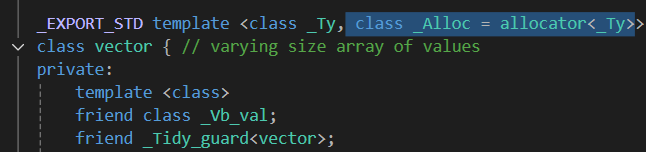
- STL Allocator를 만들어 Allocator를 대체하는 메모리 체크 버전 STL 컨테이너를 따로 만들어서 메모리 할당 로직 중간에 개입하거나, 오류를 탐색할 때 사용할 수 있음
vector<int32, BaseAllocator> v;- 이렇게 넣으면 될 것 같지만 STL 컨테이너마다 내부에서 기본적으로 요구하는 함수들이 BaseAllocator에 모두 구현되어 있지 않을 확률이 큼
- vector 뿐만 아니라 stack, queue 등 다른 컨테이너들도 자신들만의 매개변수가 다를 것임
Allocator.h
/*-------------------------
	STL Allocator
-------------------------*/

template <typename T>
class StlAllocator {
public:
	using value_type = T;

	StlAllocator() {}

	template <typename Other>
	StlAllocator(const StlAllocator<Other>&) {}
	// 오류 해결용으로 작성

	T* allocate(size_t count) {
		const int32 size = static_cast<int32>(count * sizeof(T));
		return static_cast<T*>(xxalloc(size));
	}

	void deallocate(T* ptr, size_t count) { xxrelease(ptr); }
};- allocate(size_t n): 단순히 n * sizeof(T) 만큼의 메모리를 빌려오는 역할로, 여기서 내부적으로 xxalloc을 호출
- deallocate(T* ptr, size_t n): 빌렸던 메모리를 다시 xxrelease를 통해 돌려줌
- 다음과 같이 StlAllocator의 기본틀을 잡아놓고, 이전에 만들었던 Allocator(xxalloc, xxrelease)로 메모리 할당을 대신해 줌
- CoreMacro.h에 설정된 모드별 Allocator(StompAllocator or BaseAllocator)로 메모리 할당 로직이 돌아감
- xnew와 달리 여기서 객체의 생성자/소멸자를 직접 호출하지는 않음
- 그건 STL 컨테이너가 내부적으로 알아서 할 일이고, 이 할당자는 오직 메모리 덩어리만 가져다주는 역할에 충실
Container.h (rebind)
template <typename T>
using Vector = vector<T, StlAllocator<T>>;

template <typename T>
using List = list<T, StlAllocator<T>>;

template <typename Key, typename T, typename Pred = less<Key>>
using Map = map<Key, T, Pred, StlAllocator<pair<const Key, T>>>;

template <typename Key, typename Pred = less<Key>>
using Set = set<Key, Pred, StlAllocator<Key>>;

template <typename T>
using Deque = deque<T, StlAllocator<T>>;

template <typename T, typename Container = Deque<T>>
using Stack = stack<T, Container>;

template <typename T, typename Container = Deque<T>>
using Queue = queue<T, Container>;

template <typename T, typename Container = vector<T>, typename Pred = less<T>>
using PriorityQueue = priority_queue<T, Container, Pred>;

using String = basic_string<char, char_traits<char>, StlAllocator<char>>;
using Wstring = basic_string<wchar_t, char_traits<wchar_t>, StlAllocator<wchar_t>>;

template <typename Key, typename T, typename Hasher = hash<Key>, typename KeyEq = equal_to<Key>>
using HashMap = unordered_map<Key, T, Hasher, KeyEq, StlAllocator<pair<const Key, T>>>;

template <typename Key, typename Hasher = hash<Key>, typename Keyeq = equal_to<Key>>
using HashSet = unordered_set<Key, Hasher, Keyeq, StlAllocator<Key>>;- 다음과 같이 STL 컨테이너들이 필요로 하는 매개변수를 맞춰주고, allocator를 STL Allocator로 설정하여 각 STL 컨테이너가 메모리 할당을 할 때, 사용자가 설정한 Allocator로 STL 컨테이너들의 메모리 할당 로직을 수정할 수 있음
PriorityQueue: 같은 Pred = less<T>인데 오름차순, 내림차순이 다른 이유
- std::map과 std::set은 내부적으로 이진 탐색 트리(정확히는 Red-Black Tree) 구조를 사용
- std::less 적용 시: 작은 값이 왼쪽, 큰 값이 오른쪽에 배치
- PriorityQueue도 내부적으로 less를 써서 비교하는 것은 같지만, 우선순위(누구를 제일 위에 둘 것인가)의 개념이 추가되기 때문에 정렬 방식이 다름
- Map, Set: 전체 데이터를 순서대로 줄 세우기 → less면 작은 게 앞으로(오름차순)
- PriorityQueue: 가장 우선순위가 높은 놈 하나만 맨 위에 올리기 → C++ 표준은 값이 클수록 우선순위가 높다고 정의하므로, less를 쓰면 가장 큰 값이 top()에 오게 되어, 꺼낼 때 내림차순으로 보이게 됨
| 컨테이너 | 내부 구조 | 정렬/출력 형태 | 특징 |
| Set / Map | Red-Black Tree | 오름차순 (1, 2, 3...) | begin()부터 순회하면 작은 값부터 나옴 |
| Vector / List | 선형 구조 | 정렬 안 됨 | 넣은 순서대로 유지됨 |
| PriorityQueue | Heap | 내림차순 (10, 9, 8...) | pop() 할 때 큰 값부터 나옴 (Max Heap) |
'C++ > Game Server' 카테고리의 다른 글
| [C++/Game Server] Stomp Allocator (Use-after-free & Overflow 오류 검증) (1) | 2026.03.10 |
|---|---|
| [C++/Game Server] Allocator (New, Delete Operator Overloading) + std::forward, Placement New (0) | 2026.03.10 |
| [C++/Game Server] Reference Counting (in Shared Pointer) (1) | 2026.03.07 |
| [C++/Game Server] DeadLock Profiler (+ release, debug 모드) (0) | 2026.02.19 |
| [C++/Game Server] Reader-Writer Lock (0) | 2026.02.12 |
'C++/Game Server' Related Articles
more


